Tür
Xanthoria parietina (L.) Th.Fr.
Genel bakış
Xanthoria parietina, Ascomycota şubesinin Lecanoromycetes sınıfına bağlı Teloschistales takımında, Teloschistaceae familyasında yer alan bir mantar türüdür.
GBIF'te Türkiye'den 500 kaydı bulunur; tamamı fiziksel kanıtaFiziksel kanıt Bir türün bir yerde bulunduğunu, organizmanın doğrudan görülmesi, fotoğraflanması ya da toplanması yoluyla gösteren kanıt (gözlem, herbaryum örneği, literatür); çevresel DNA kayıtlarından ayrı tutulur. (gözlem, fungaryumMikobiyota Belirli bir bölge ya da habitatta bulunan mantar türlerinin tümü. örneği ya da yayın kaydı) dayanır. Bunların 463'ü insan gözlemi ve 37'si korunmuş örnektirHerbaryum örneği Toplanma yeri, tarihi ve toplayıcı bilgisiyle birlikte bir herbaryum ya da benzer bir koleksiyonda korunan kurutulmuş örnek; GBIF'te 'preserved specimen' (korunmuş örnek) türü olarak geçer.. Fiziksel kayıtlar 41 ilden gelir ve geniş bir yayılış gösterir; en çok kayıt İstanbul (219), Ankara (52) ve Eskişehir (23) illerindedir. Kayıtların %61'i Marmara Bölgesi'ndendir.
Gözlemler en çok Şubat–Mayıs döneminde yoğunlaşır; kayıtların %51'i bu aylara aittir. Türkiye'deki en eski tarihli fiziksel kayıt 1840, en yenisi 2026 yılına aittir. Kayıtların %93'ü son on yılda (2017–2026) toplanmıştır; bu artış büyük ölçüde iNaturalist gibi yurttaş bilimi platformlarına yüklenen gözlemlerden kaynaklanır.

Sınıflandırma
- Âlem
- Mantarlar (Fungi)
- Şube
- Ascomycota
- Sınıf
- Lecanoromycetes
- Takım
- Teloschistales
- Familya
- Teloschistaceae
- Cins
- Xanthoria
- Tür
- Xanthoria parietina (L.) Th.Fr.
Türkiye kayıtları
- Fiziksel kayıt
- 500
- Çevresel DNA kaydı
- 0
- Kayıtlı il
- 41 il
- Fiziksel kayıt yılları
- 1840–2026
- Yoğun dönem
- Şubat–Mayıs
Türkiye'de yayılış
| İl | Fiziksel | DNA |
|---|---|---|
| İstanbulSarıyer (41), Çatalca (21), Beşiktaş (14), Avcılar (8), Bakırköy (7), Tuzla (6) | 219 | – |
| AnkaraÇankaya (35), Gölbaşı (6) | 52 | – |
| EskişehirMerkez (5) | 23 | – |
| MuğlaMerkez (6) | 18 | – |
| YozgatMerkez (7) | 15 | – |
| BalıkesirMerkez (4) | 13 | – |
| Çanakkale | 10 | – |
| Antalya | 9 | – |
| Bolu | 7 | – |
| Bursa | 6 | – |
| Aydın | 5 | – |
| İzmir | 5 | – |
| BilecikMerkez (2) | 4 | – |
| EdirneKeşan (3) | 4 | – |
| ManisaSalihli (3) | 4 | – |
| Samsun | 4 | – |
| Yalova | 4 | – |
| KastamonuMerkez (3) | 3 | – |
| SakaryaMerkez (2) | 3 | – |
| Tekirdağ | 3 | – |
| Trabzon | 3 | – |
| Aksaray | 2 | – |
| Düzce | 2 | – |
| Kocaeli | 2 | – |
| Kütahya | 2 | – |
| Mersin | 2 | – |
| Adana | 1 | – |
| Amasya | 1 | – |
| Artvin | 1 | – |
| Burdur | 1 | – |
| Denizli | 1 | – |
| Diyarbakır | 1 | – |
| Gaziantep | 1 | – |
| Isparta | 1 | – |
| Karabük | 1 | – |
| Karaman | 1 | – |
| Kayseri | 1 | – |
| Kırklareli | 1 | – |
| Nevşehir | 1 | – |
| Ordu | 1 | – |
| Osmaniye | 1 | – |
İlçe dağılımı, ayrıntılı incelenen 300 fiziksel kayda dayanır.
Mevsimsellik ve kayıt geçmişi
| Ay | Kayıt |
|---|---|
| Ocak | 37 |
| Şubat | 33 |
| Mart | 71 |
| Nisan | 37 |
| Mayıs | 107 |
| Haziran | 23 |
| Temmuz | 57 |
| Ağustos | 40 |
| Eylül | 30 |
| Ekim | 18 |
| Kasım | 15 |
| Aralık | 18 |
| Yıl | Fiziksel | DNA |
|---|---|---|
| 1980 öncesi | 15 | 0 |
| 1983 | 1 | 0 |
| 1992 | 2 | 0 |
| 1993 | 2 | 0 |
| 1996 | 1 | 0 |
| 2002 | 1 | 0 |
| 2003 | 1 | 0 |
| 2007 | 1 | 0 |
| 2010 | 4 | 0 |
| 2011 | 1 | 0 |
| 2012 | 1 | 0 |
| 2014 | 2 | 0 |
| 2015 | 3 | 0 |
| 2016 | 1 | 0 |
| 2017 | 1 | 0 |
| 2018 | 3 | 0 |
| 2019 | 1 | 0 |
| 2020 | 12 | 0 |
| 2021 | 17 | 0 |
| 2022 | 37 | 0 |
| 2023 | 29 | 0 |
| 2024 | 56 | 0 |
| 2025 | 190 | 0 |
| 2026 | 111 | 0 |
Türkiye'den fotoğraflar
GBIF'e aktarılmış, açık lisanslı kayıt fotoğrafları.
-
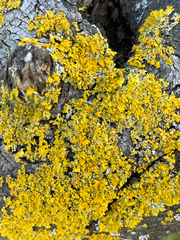
Sakarya · 2026 Bora Çelen · CC BY-NC 4.0 · iNaturalist -
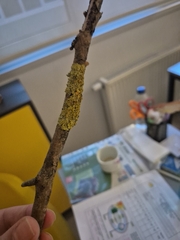
İstanbul, Çekmekoy · 2026 yeryuzundehilal · CC BY-NC 4.0 · iNaturalist -
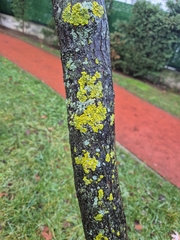
Türkiye · 2026 yeryuzundehilal · CC BY-NC 4.0 · iNaturalist -
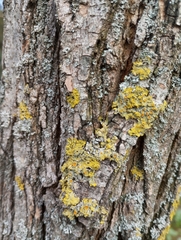
İstanbul, Şişli · 2026 Yusuf · CC BY-NC 4.0 · iNaturalist -
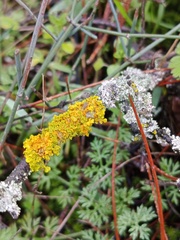
Manisa, Salihli · 2026 Umut Nuri Erdoğan · CC BY 4.0 · iNaturalist -
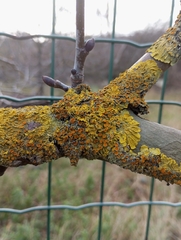
İstanbul, Şişli · 2026 Yusuf · CC BY-NC 4.0 · iNaturalist -
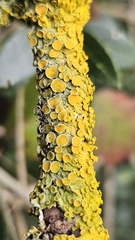
İstanbul, Sarıyer · 2026 Songül Sönmez · CC BY-NC 4.0 · iNaturalist -
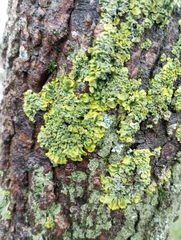
İstanbul, Beyoğlu · 2026 Yusuf · CC BY-NC 4.0 · iNaturalist
Vikipedi'den
İngilizce Vikipedi'den: “Xanthoria parietina”
Xanthoria parietina is a common and widespread lichen-forming fungus in the family Teloschistaceae. Commonly known as the yellow wall lichen, common orange lichen, or maritime sunburst lichen, this leafy lichen is known for its vibrant yellow to orange coloration and environmental adaptability. First described by Carl Linnaeus in 1753, it has become one of the most thoroughly studied lichens, contributing significantly to scientific understanding of lichen biology. Unlike many lichens that are sensitive to pollution, X. parietina grows in diverse habitats—including coastal rocks, urban walls, and tree bark—even in areas with high levels of air pollution and excess nitrogen. Its structure consists of small, overlapping lobes that typically measure less than 8 cm (3+1⁄8 in) across, with coloration that varies from bright orange in sun-exposed locations to greenish-yellow in shaded environments.
The lichen represents a symbiotic partnership between a fungus and green algae of the genus Trebouxia. Its distinctive orange-yellow color comes from parietin, an anthraquinone pigment that accumulates in the outer cortex and serves as a natural sunscreen, protecting the algal partner from excessive light and ultraviolet radiation. Unlike many lichens that reproduce through specialized vegetative structures, X. parietina primarily relies on sexual reproduction through cup-shaped fruiting bodies (apothecia), each of which can release up to 50 spores per minute under humid conditions. When fungal spores germinate, they initially form preliminary associations with common free-living algae in their vicinity. Additionally, the fungus can recruit compatible algal cells from neighboring lichen thalli—essentially extracting these partners—to help establish a complete symbiotic relationship.
Native across Europe, parts of Asia, and coastal North Africa, X. parietina has a more limited and primarily coastal distribution in North America and Australia, where genetic evidence suggests human-mediated introduction. In recent decades, it has expanded inland in these regions, particularly in urban environments and areas affected by agricultural runoff, road salt application, and nitrogen deposition. The lichen grows slowly (averaging 2.6 mm (1⁄8 in) per year) but possesses considerable regenerative abilities, with fragments capable of developing into new thalli. It participates in a complex web of ecological interactions, hosting at least 41 species of lichen-dwelling fungi, while certain gastropods and microscopic rotifers contribute to its dispersal by consuming and excreting viable spores.
The species has high diversity even within local populations, with distinct patterns linked to both geographic location and substrate type. This genetic variability, combined with the lichen's flexible associations with different photobiont strains, contributes to its ecological success. X. parietina serves as a bioindicator for monitoring air quality due to its capacity to accumulate environmental contaminants. Historically, it was used in folk medicine to treat jaundice and as a natural dye source for textiles. More recently, it has become a subject of astrobiology research, where it survives Mars-like environments, space vacuum, cosmic radiation, and extreme cold. This resilience has established X. parietina as a model organism in both environmental monitoring and space exploration research.
Systematics
Historical taxonomy
The taxonomic history of Xanthoria parietina begins in 1753 with Carl Linnaeus, who first described it as Lichen parietinus in his landmark work Species Plantarum. In his brief diagnosis, Linnaeus characterized it as a foliose lichen with curled yellowish-brown lobes and a matching surface, citing Dillenius's earlier depiction and noting its broad European distribution on walls, rocks, and wood. Linnaeus's original specimens of Lichen parietinus are preserved in the Linnaean Herbarium (LINN), both labeled with his Species Plantarum number 25. These specimens have caused taxonomic confusion, as one actually corresponds to Rusavskia elegans (formerly Xanthoria elegans), while the other has features resembling Xanthoria ectaneoides. A separate specimen in his Flora Suecica collection was later reassigned to X. parietina. Due to these inconsistencies, taxonomists designated the illustration cited by Linnaeus from Dillenius (1742) as the lectotype, with a corresponding specimen in the Oxford herbarium (OXF) designated epitype.
İngilizce Vikipedi, “Xanthoria parietina” maddesi · CC BY-SA 4.0 · Çevrilmemiş özgün metin
Veri kaynakları
Veri setleri
ve 9 veri seti daha.
Kayıt temeli
| İnsan gözlemi | 463 |
|---|---|
| Korunmuş örnek (fungaryum/herbaryum) | 37 |
Gözlemciler
M. B. 69; linetellina 44; Koray Öğreten 30; Yusuf 25; Esin Murat 6; Zemfira Aliyeva 5; Enis Çakar 4; Tomasz Wilk 4; Umut Nuri Erdoğan 4; sud4 3